
· The DigDug team
Learn irregular verbs for French speakers
If you searched for “learn irregular verbs for French people”, “English irregular verbs for French speakers”, “verbes irréguliers anglais pour francophones”, “apprendre les verbes irréguliers en anglais”, you are probably not looking for another three-column worksheet. You already know go — went — gone on paper; the hard part is producing went and gone at speaking speed without translating through spelling first. That gap is exactly what this guide is for French speakers.
DigDug is built around that problem: hear each form, hear the translation in your language where available, and repeat until the sound sticks. Tables still have their place — the full verb list is there when you need it — but listening is what trains the reflex you use in conversation.
Why French speakers find irregular verbs hard
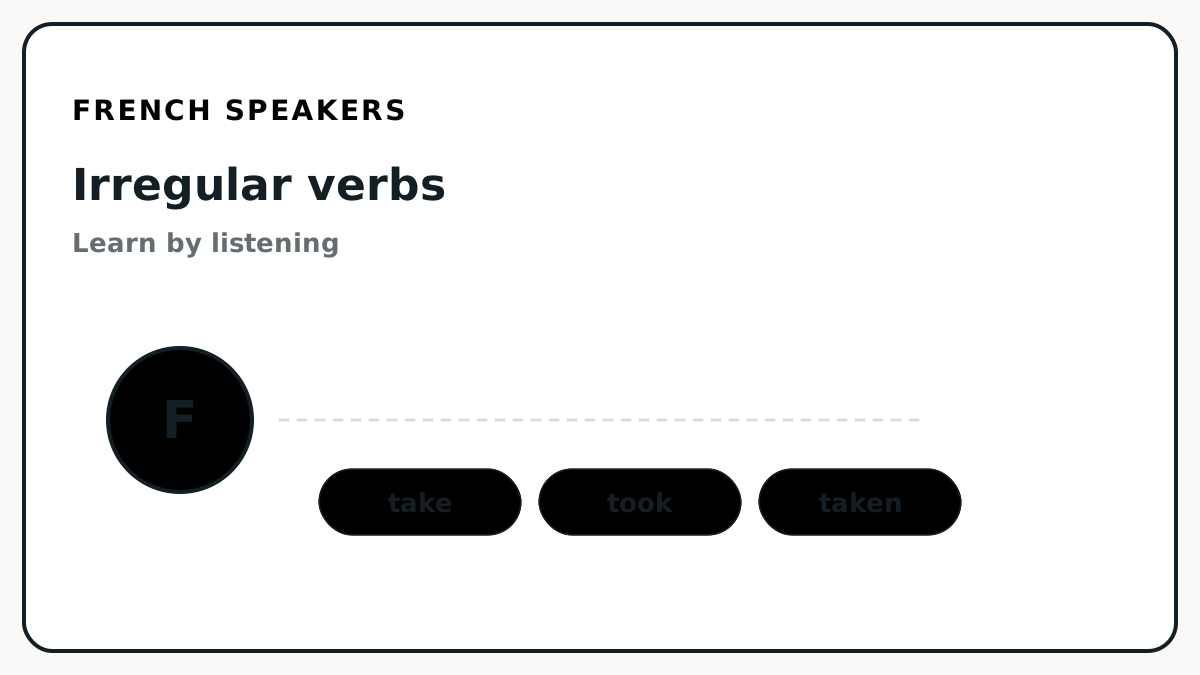
- French regular -er verbs give a false sense that English will follow -ed everywhere; prendre → pris is irregular in French too, but English hides the pattern behind spelling (take / took / taken).
- Silent letters in French prepare you for spelling oddities, not for vowel shifts you cannot see on the page (sing / sang / sung).
- French compound tenses reuse the participle (j’ai mangé); English needs a distinct participle form more often (write / wrote / written), and the -en ending is easy to skip when reading silently.
These are not random exceptions. Most of the 200 verbs you actually need cluster into fifteen vowel and spelling families — the chaos is mostly an alphabetical illusion.
Three verbs worth drilling first
Start with high-frequency forms where French and English diverge sharply:
- take / took / taken (prendre) — detail page
- write / wrote / written (écrire) — detail page
- sing / sang / sung (chanter) — detail page
The i a u pattern covers several of these — once you hear the shared shape, the next verb in the family costs far less effort.
How to practice without a streak app
The i → a → u family (sing / sang / sung, drink / drank / drunk) rhymes in English the way French strong verbs echo across the conjugation — hear three in a row and the shape becomes predictable.
That is the loop DigDug runs: pick a verb, hear base → past → participle, hear the gloss, repeat. No gamified streak — just the sounds, in order, until your mouth catches up to what your textbook already showed you.
Where to go next
- Browse the pattern families and drill one family per session.
- Look up any verb on its detail page — IPA, forms, and translations included.
- Read why “go, went, gone” is not a spelling problem for the method behind the player.
If “learn irregular verbs for French speakers” brought you here, you already know the forms exist. The next step is hearing them often enough that they stop feeling irregular.