Hear the full sequence
You hear the base form, then past, then participle — one after another. The pattern sticks because you heard it, not because you read a row in a table.
200 irregular English verbs, spoken base → past → participle, hands-free, with IPA and translations in 9 languages. Press play and listen — on a walk, on a commute, with your phone in your pocket.
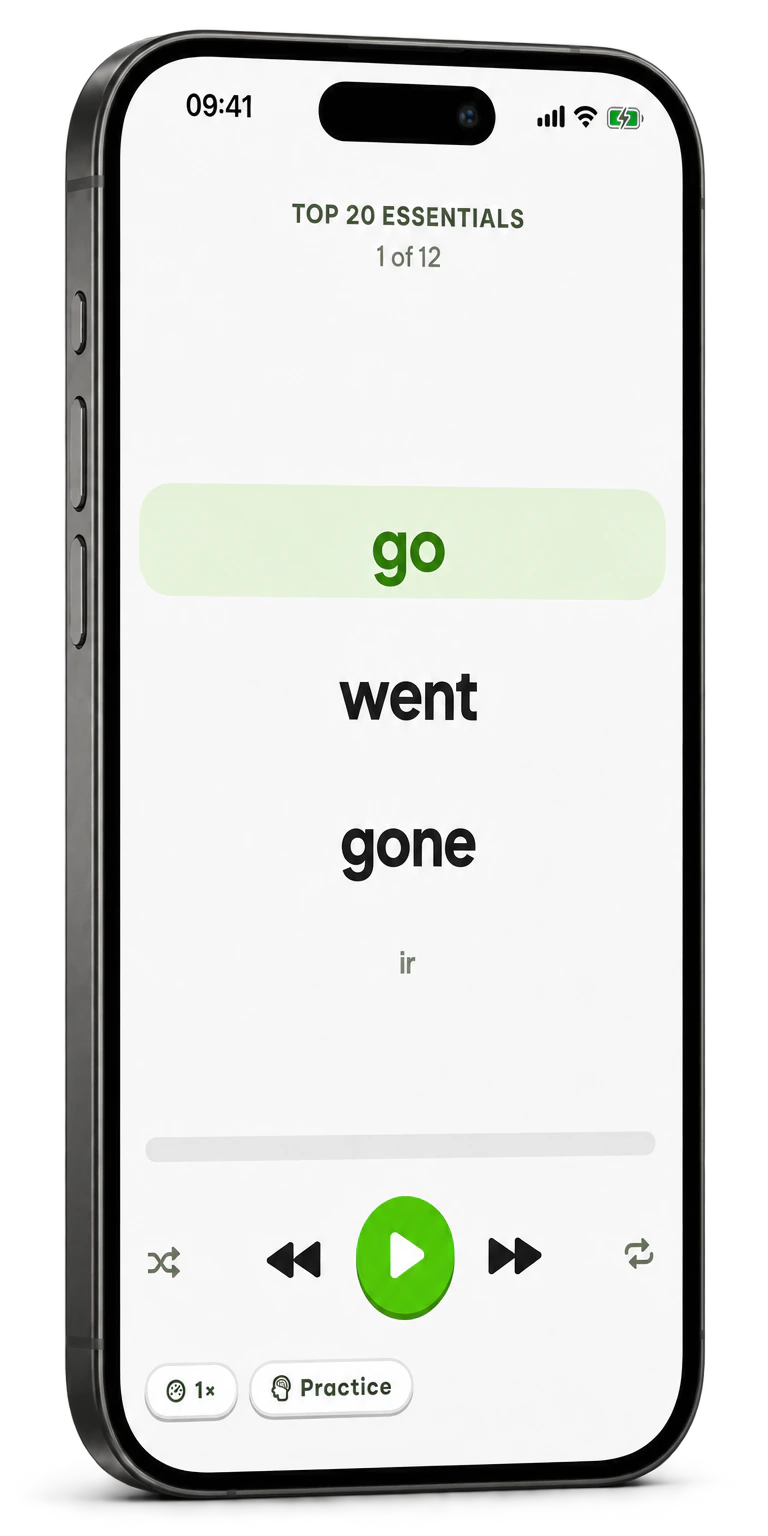
Base: go. Past: went. Participle: gone.
Three ways the usual approach to irregular verbs works against how they're actually learned.
A printed list of 200 rows asks you to memorize spelling. It never tells you how any of it sounds.
Streaks and points measure whether you opened the app, not whether you've learned the verb.
Irregular verbs aren't random — they fall into families that share a vowel shift. That pattern is audible, but only if you hear it.
How it works
Each verb plays its three forms in sequence — hands-free, at a pace you choose, wherever you are.
You hear the base form, then past, then participle — one after another. The pattern sticks because you heard it, not because you read a row in a table.
Start slow while a verb is new, speed up once it clicks. You set the pace — the sequence stays the same.
Lock the screen, pocket your phone, keep walking. Playback continues with lock-screen controls — no need to watch anything.
Verbs are grouped into 15 families that share a vowel shift — i → a → u, ought/-aught, and more — so you learn the pattern, not 200 isolated words.
200 verbs, each one spoken aloud with IPA and translations — nothing left to guess.
Every verb you play is saved for offline use — automatically. On the subway, on a flight, or anywhere without Wi-Fi, just press play. Your practice never stops.
Downloaded playlists
The highest-frequency verbs, no time limit.
The full corpus, billed month to month.
The same plan, paid yearly — usually the better rate.
Exact prices are set by the App Store for your country and currency, and are shown before you buy — never here. Full details →